Why the Right Accessories Matter in Sludge Treatment Plants
When designing or upgrading a sludge treatment plant, the focus is usually on selecting the main piece of equipment. Belt presses, screw presses and thickeners are evaluated based on flow rate, sludge characteristics and treatment objectives. But how much do the accessories that work alongside this equipment matter?
Pumps, mixers and conveying systems directly affect process continuity, dewatering efficiency and the day-to-day operation of the plant.
An irregular feed rate or ineffective mixing, for example, can compromise the performance of the entire line, even when the main equipment has been correctly selected.
That is why Teknofanghi has developed a range of accessories that complement its sludge treatment equipment and can also be integrated into existing plants.
Before water and solids can be separated, the sludge must be conditioned by adding a polyelectrolyte. Mixing quality directly affects floc formation and, in turn, the performance of the dewatering equipment.
If the polymer is distributed unevenly, some of the sludge may receive too little reagent while other portions receive too much. This makes flocculation less effective and can affect both polymer consumption and the dry solids content achieved.
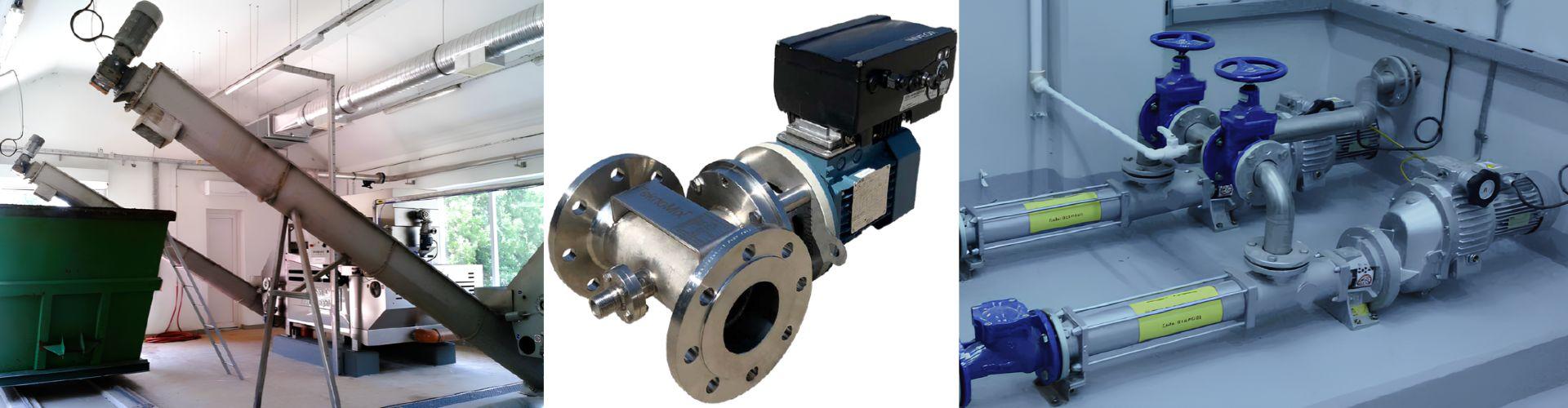
To improve this stage, we developed TEKNOMIX+®, a range of dynamic inline mixers with adjustable impeller speed to suit different sludge characteristics.
Adjusting the speed helps strike the right balance between mixing energy and turbulence. The polyelectrolyte needs to be distributed evenly while limiting excessive shear that could break up flocs that have already formed.
TEKNOMIX+® helps reduce polyelectrolyte consumption and increase the dry solids content achieved during the subsequent dewatering stage.
Process continuity also depends on how consistently sludge is fed into the dewatering equipment. An unstable flow rate can cause operating conditions to fluctuate, making it harder to maintain a consistent sludge-to-polymer ratio. Reagent dosing also needs to match the volume and characteristics of the sludge being treated.
Progressive cavity pumps, also known as eccentric screw pumps, are used for both tasks. The pumps in our accessory range are primarily used for:
• Feeding sludge into dewatering equipment
• Dosing polyelectrolyte during sludge conditioning
Their ability to handle viscous fluids and sludges with varying characteristics makes them particularly useful in municipal and industrial wastewater treatment plants. A correctly sized pump helps maintain a steady feed rate and allows polymer dosing to be adjusted to suit operating conditions.
Once the liquid fraction has been separated, the dewatered sludge must be transferred from the equipment to the collection point. This stage can easily be overlooked during plant design, even though it can affect the continuous operation of the entire line.
Dewatered sludge has a very different consistency from incoming sludge. Depending on its composition and the degree of dewatering, it can be compact, viscous or difficult to move.
For this stage, we supply shaftless screw conveyors that transfer dewatered sludge to designated collection containers. The shaftless design makes it easier to convey dense, paste-like materials and helps reduce material build-up during transport.
The range includes standard models and custom configurations for plants with specific requirements. The choice depends on several factors, including the volume of sludge to be conveyed, the distance between the equipment and the collection point, the conveyor incline and the available space.
A common mistake when designing a sludge treatment line is to leave the selection of accessories until after the dewatering equipment has been chosen.
Each component needs to be sized with the requirements of the entire process in mind. Consider an industrial plant that treats sludge with varying characteristics. The dewatering equipment may have sufficient capacity, but an undersized feed pump could limit its actual throughput. Similarly, inefficient mixing can increase polyelectrolyte consumption without improving dewatering performance. A screw conveyor with insufficient capacity can also slow the discharge of dewatered sludge.
Assessing these factors early in the design process helps identify potential bottlenecks and select components that work together.
Accessories play an important role at every stage of sludge handling, from feeding and mixing with polyelectrolyte to conveying the dewatered material.
Teknofanghi complements its treatment equipment with dedicated accessories, taking into account sludge characteristics, flow rates, available space and the plant’s operating requirements.
Which accessories does your plant need? Contact us or ask us when you request a quote.